Statuspage Alternatives: 7 Cheaper Options in 2026 (incl. Instatus)
Compare 7 Atlassian Statuspage alternatives: Statuspage pricing explained, free plans, the cheapest custom-domain status page, open source options, and Instatus alternatives.
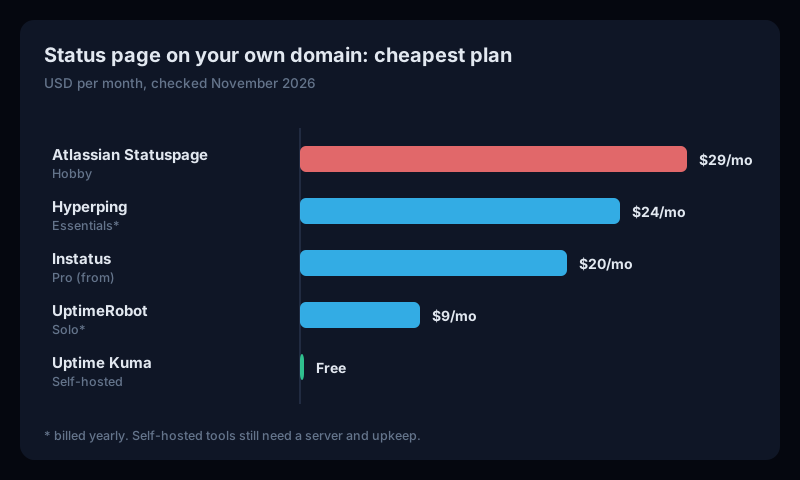
Atlassian Statuspage is the best-known status page tool, and for many small teams it's also the most expensive one to grow into. A page on your own domain starts at $29 a month, more subscribers push you to $99, and Statuspage doesn't monitor anything itself, so you still need a separate monitoring tool to know when to post an incident. That's why so many people search for a Statuspage alternative.
This guide compares 7 of them, hosted and self-hosted, with prices checked on each provider's pricing page in November 2026. If you're on Instatus and looking around, there's a section for Instatus alternatives too.
Statuspage pricing: what you actually pay
Statuspage splits its pricing into public pages (for customers) and private pages (for your own team). Here's the public side:
- Free: 100 subscribers, 25 components, two team members. No custom domain.
- Hobby, $29/month: 250 subscribers and a custom domain.
- Startup, $99/month and Business, $399/month: more subscribers, components, and team members.
- Enterprise, $1,499/month.
Private pages start at $79/month (Starter) and audience-specific pages at $300/month. None of these plans include monitoring: Statuspage shows what you tell it, so outages only appear once someone posts them.
What to look for in a Statuspage alternative
- Custom domain price: how much does status.yourcompany.com cost?
- Subscribers: can customers get email updates, and how many are included?
- Automatic updates: does the page change by itself when a check fails, or does someone have to post an incident?
- Hosted or self-hosted: a free open-source tool still costs a server and your time.
The 7 best Statuspage alternatives in 2026
1. Uptura: best for automatic status pages and agencies
Uptura's status pagesare built on its own monitoring. Each site shows operational, degraded, or down straight from Uptura's uptime and API checks, with daily uptime bars and an incident log that fill in by themselves, so nobody has to post an update at 3 a.m. One page is free, forever. Pro ($19/month) gives you 5 pages with your logo and no Uptura branding, and Scale ($49/month) gives you 25. Both prices include the monitoring itself: uptime, SSL, DNS, API, cron jobs and more.
For agencies, client workspaces let you publish a status page per client in one click, with that client's sites, logo, and colors. Two honest limits: pages live at an uptura.io/status/ address (custom domains are planned), and there are no email subscribers yet. If those matter most, look at Instatus or UptimeRobot below.
2. Instatus: best fast, simple hosted pages
Instatus is the closest like-for-like Statuspage replacement: clean hosted pages, incident updates, and subscribers. Its free Starter plan includes a public status page and 200 subscribers, but no custom domain. Pro starts at $20/month and adds a custom domain and 5,000 subscribers, and yearly billing is 25% off. If you want Statuspage's workflow at a fraction of the price, start here.
3. Better Stack: best for incidents and on-call
Better Stack combines uptime monitoring, on-call scheduling, and status pages. The free tier covers 10 monitors and heartbeats plus 1 status page. Extra public status pages cost $15/month each ($12 billed yearly), with 1,000 subscribers included, and the incident and on-call product (Responder) is $34/month. White-labeling is an expensive add-on at $250 per page per month, so it suits teams that want incident management more than branding.
4. UptimeRobot: cheapest custom domain
UptimeRobot's free plan includes one basic status page alongside 50 monitors at 5-minute checks, but the free plan is for personal, non-commercial use only. The Solo plan, $9/month billed yearly, gives you 3 status pages on your own domain, which is the cheapest hosted custom domain on this list. Team ($35/month billed yearly) adds 100 white-label pages. More in our UptimeRobot alternatives guide.
5. Hyperping: best polished pages with monitoring
Hyperping pairs uptime monitoring with good-looking hosted status pages. The free plan includes 20 monitors and 1 basic status page, without a custom domain or subscribers. Essentials, $24/month billed yearly, adds a custom domain and 100 subscribers. Pro ($74/month billed yearly) gives 3 pages and 1,000 subscribers.
6. Uptime Kuma: best free, self-hosted option
Uptime Kuma is an open-source (MIT) monitoring tool you run yourself with Docker or Node.js. It supports multiple status pages and can map them to your own domains, so a custom-domain status page costs nothing beyond your server. The trade-off is upkeep: you install it, update it, back it up, and make sure it stays online. A status page that goes down with your server doesn't help much, so host it somewhere separate.
7. Cachet: self-hosted status page only
Cachet is an open-source, self-hosted status page system built on PHP and Laravel, currently being rebuilt as version 3. Unlike Uptime Kuma it's only a status page: you post incidents and component status yourself or through its API, and connect your own monitoring. Good if you want full control and already have monitoring.
Statuspage alternatives compared
| Tool | Best for | Free plan | Custom domain | Hosting |
|---|---|---|---|---|
| Uptura | Automatic pages + agencies | 1 page, auto-updated | Not yet | Hosted |
| Instatus | Fast, simple hosted pages | Yes, 200 subscribers | Pro, from $20/mo | Hosted |
| Better Stack | Incidents + on-call | 1 page, 10 monitors | Custom subdomain; extra pages $15/mo | Hosted |
| UptimeRobot | Cheapest custom domain | 1 basic page (personal use) | Solo, $9/mo billed yearly | Hosted |
| Hyperping | Polished pages + monitoring | 1 basic page, no subscribers | Essentials, $24/mo billed yearly | Hosted |
| Uptime Kuma | Free, self-hosted | Free (open source, MIT) | Yes (your server) | Self-hosted |
| Cachet | Self-hosted status page only | Free (open source) | Yes (your server) | Self-hosted |
For comparison, Atlassian Statuspage's custom domain starts at $29/month (Hobby). Prices were checked on each pricing page in November 2026 and change often, so confirm before you buy.
Instatus alternatives
Instatus is already one of the cheaper Statuspage alternatives, so people usually leave it for one of three reasons:
- You want monitoring built in, so the page updates itself: Uptura, Better Stack, Hyperping, or UptimeRobot.
- You want a cheaper custom domain: UptimeRobot Solo is $9/month billed yearly.
- You want to pay nothing and host it yourself: Uptime Kuma or Cachet.
How to choose
- Statuspage's workflow, lower price: Instatus.
- Cheapest custom domain: UptimeRobot Solo.
- Incident management and on-call: Better Stack.
- Free and self-hosted: Uptime Kuma.
- A page that updates itself, plus one per client: Uptura.
Keep your status page off your own servers
Statuspage alternatives FAQ
Is Atlassian Statuspage free?
Statuspage has a free public plan with 100 subscribers, 25 components, and two team members. A custom domain, like status.yourcompany.com, starts on the Hobby plan at $29/month, and the Startup plan is $99/month. Private (internal) pages start at $79/month.
What is the best free Statuspage alternative?
If you want a free hosted page, Instatus (200 subscribers on its free plan), Better Stack (1 status page with 10 monitors), and Uptura (1 status page that updates itself from monitoring) are good picks. If you can run your own server, Uptime Kuma is free and open source, and lets you put status pages on your own domain.
What is the cheapest Statuspage alternative with a custom domain?
Of the hosted tools we checked, UptimeRobot's Solo plan is the cheapest way to get a status page on your own domain, at $9/month billed yearly (3 status pages). Instatus Pro starts at $20/month. Self-hosted tools such as Uptime Kuma cost nothing beyond your server.
Is there an open source status page?
Yes. Uptime Kuma (MIT license) is a self-hosted monitoring tool with multiple status pages that you can map to your own domains. Cachet is a self-hosted status page system built on Laravel. Both are free, but you have to host, update, and back them up yourself.
Why do people look for a Statuspage alternative?
Mostly price. A custom domain starts at $29/month, more subscribers mean $99/month or more, and private pages start at $79/month. Statuspage also doesn't monitor anything itself, so you still pay for a separate monitoring tool and update incidents by hand.
A status page that updates itself
If the reason you want a Statuspage alternative is that nobody remembers to post incidents, a page fed by monitoring fixes that. With Uptura status pages, live status, uptime history, and incidents come straight from Uptura's checks, and one page is free forever. Agencies can publish one page per client from their client workspaces. Create a free account and have a page live in a few minutes.